Before you pay a deposit on a house, villa or plot of land around Pattaya, look at the land document. Thai title deed types range from full freehold ownership to a simple tax receipt, and the document decides what can legally be sold, leased or mortgaged. This guide explains each one in plain English, how to check it at the Land Office, and what it means for a foreign buyer.
Thai title deed types mainly matter for houses and land. Condo buyers have an easier path, because a condo unit comes with its own condominium title deed. We cover that at the end, together with the questions we hear most often from clients.
Thai Title Deed Types at a Glance
Thailand’s Land Department issues several kinds of land document, and the Thai title deed types are easy to confuse because the names sound alike. Only one of them, the Chanote, is full ownership. The others record a right to possess or use the land, and some cannot be sold at all. From strongest to weakest, the main Thai title deed types are:
- Chanote (Nor Sor 4 Jor) – full freehold ownership, surveyed by GPS.
- Nor Sor 3 Gor – confirmed right of possession, surveyed from aerial photographs.
- Nor Sor 3 – right of possession without an accurate survey.
- Sor Kor 1 – a notification that someone possesses the land; not ownership.
- Sor Por Gor 4-01 – land reform land allocated for farming; cannot be sold.
You may also see a Por Bor Tor 5, which is a land-use tax receipt and gives no ownership right. A quick visual clue: according to ThaiLawOnline’s title deed guide, the Chanote carries a red Garuda emblem, the Nor Sor 3 Gor a green Garuda and the Nor Sor 3 a black Garuda.
Chanote (Nor Sor 4 Jor): Full Ownership
Of all the Thai title deed types, the Chanote is the highest level of land document in Thailand. It confers full freehold title, and the plot has been surveyed by GPS with numbered concrete marker posts on the boundary. Because the boundaries are fixed on the national grid, disputes with neighbours are far less likely than with the lower documents.
All the usual real rights can be registered on a Chanote: sale, lease, mortgage, usufruct and superficies. That matters for foreign buyers, because a registered long lease or a superficies (the right to own a building on someone else’s land) is how most foreigners hold a house.
Many house and land listings around Pattaya state a Chanote title, but never assume it. Ask to see a copy of the deed, front and back, before you reserve anything.
Nor Sor 3 Gor and Nor Sor 3: Possession Rights
Nor Sor 3 Gor (NS3G)
A Nor Sor 3 Gor is a certificate of use that confirms a right of possession, not ownership. Its boundaries are taken from aerial photograph survey points rather than a GPS ground survey, so they are reasonably accurate but less precise than a Chanote.
In practice the Land Office registers leases, mortgages, usufructs and superficies on NS3G land, and NS3G transactions do not need the 30-day public notice that applies to a plain Nor Sor 3. The holder can petition the Land Department for a GPS ground survey to upgrade the land to a Chanote.
Nor Sor 3 (NS3)
A plain Nor Sor 3 also records possession, but the land has not been accurately measured by the Land Department, so the boundaries must be confirmed with the neighbours. Any NS3 transaction (sale, lease or mortgage) needs a 30-day public notice, posted at the Land Office, the district office and on the land itself.
For a buyer, that means a longer process and less certainty about the exact size of the plot. Neither NS3 nor NS3G is automatically a bad buy, but these Thai title deed types call for extra checks.
Sor Kor 1, Por Bor Tor 5 and Sor Por Gor 4-01
These three are where most problems start. They are sometimes listed alongside the other Thai title deed types, but none of them is a title deed in the ownership sense.
- Sor Kor 1 is a notification of possession. It does not grant ownership, and the Land Department stopped issuing new Sor Kor 1 documents in 1972. Rights pass by handing over possession or by inheritance.
- Por Bor Tor 5 is a receipt for land-use tax. It shows someone paid tax on the land, nothing more.
- Sor Por Gor 4-01 is land reform land allocated for agricultural use. It cannot be sold; it can only pass by inheritance.
If a plot is offered cheaply “with papers” and those papers turn out to be one of these, walk away or get a Thai property lawyer involved before any money changes hands.
Which Thai Title Deed Types Can a Foreigner Use?
Under Thai law a foreigner cannot own land in their own name. The Thai government’s guide to foreign property ownership describes one narrow exception: an investment of at least 40 million baht, up to 1 rai for residential use, with permission from the Minister of Interior.
The same government page lists the usual alternatives: a long-term lease of up to 30 years, buying in the name of a Thai spouse (where the land is treated as the spouse’s property), or a company with Thai shareholders in which foreigners hold no more than 49% of the shares. Company structures are closely regulated, so take legal advice before using one.
Comparing Thai title deed types matters for a lease too. Under the Civil and Commercial Code, a lease of land for more than three years is only enforceable beyond three years if it is in writing and registered at the Land Office. Because every real right can be registered on a Chanote, foreign house buyers generally prefer Chanote land and register a 30-year lease of the land plus ownership of the house. Our condo vs house in Pattaya guide compares that route with buying a condo.
Condo Units: The Condominium Title Deed
A condo unit is different from the land-based Thai title deed types. Each registered unit has its own condominium title deed, which gives freehold ownership of the unit, and a foreigner can hold it in their own name. The Condominium Act 1979 caps foreign ownership at 49% of a building, which is why the foreign quota matters so much in popular Pattaya buildings.
According to the Thai government, the money for a foreign-quota purchase must be transferred from a bank abroad to a bank in Thailand, and the buyer must obtain a letter from the condominium juristic person confirming the foreign proportion, which goes to the Land Office for the transfer. The land officer then hands over the condominium title deed. Read more in our guides to foreigner quota condos and Thai company vs foreign quota.
How to Check a Title Deed Before You Buy
Whatever the document, these checks protect you:
- Identify the document. Ask for a clear copy of the front and back and confirm which of the Thai title deed types it is.
- Match the names and numbers. The seller’s name, the deed number and the land size should match the sale agreement and the seller’s ID.
- Read the back page. Registered mortgages, leases, usufructs and other rights are recorded on the back of the deed.
- Search at the Land Office. The Department of Lands’ LandsMaps website shows basic parcel information, but it is not legal evidence. Only a check at the Land Office confirms ownership, encumbrances and seizures.
- Walk the boundary. On a Chanote, look for the marker posts. On an NS3, confirm the boundaries with the neighbours.
- Use a lawyer for the contract. We are an agency, not a law firm. For land, leases and company structures, an independent Thai property lawyer should review the documents.
At transfer, the Land Office charges a transfer fee of 2% of the official appraised value, plus taxes that depend on the seller. Who pays which part is agreed before the reservation. Our mistakes foreigners make when buying property in Thailand article covers other common pitfalls.
Chanote Land Currently Listed Near Pattaya
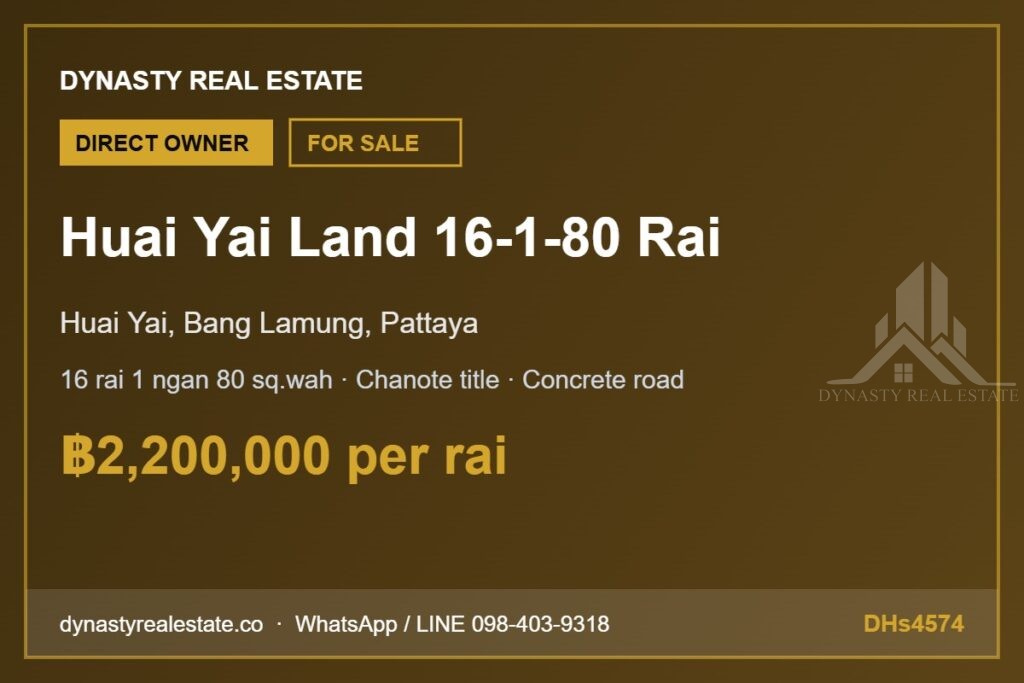
Two current direct listings show what the strongest of the Thai title deed types looks like on the market. Asking prices are the owners’ figures and can change, so we confirm them before any viewing.
- Huai Yai land, 16 rai 1 ngan 80 sq.wah – Chanote title, concrete road frontage, electricity and water available; asking 36,190,000 THB (2,200,000 THB per rai).
- Na Jomtien land plot, 2 rai 2 ngan 84 sq.wah – Chanote title, free of encumbrances, about 32 m frontage; asking 25,745,000 THB.
Browse more in our direct listings from owners, the Huay Yai houses and villas guide and Pattaya property for sale.
Frequently Asked Questions
What is the safest of the Thai title deed types?
The Chanote (Nor Sor 4 Jor). It is full freehold ownership with GPS-surveyed boundaries, and all real rights such as leases and mortgages can be registered on it.
Can a foreigner’s name be on a Chanote?
Not as the land owner, except under the rare 40-million-baht investment route. A foreigner’s name can appear on the back of a Chanote as a registered lessee, usufructuary or superficies holder.
Is Nor Sor 3 Gor land safe to buy?
It can be, with the right checks. NS3G is a confirmed possession right with surveyed boundaries, leases and mortgages can be registered, and it can be upgraded to a Chanote. It is still not full ownership, so have a lawyer review it.
Does a condo have a Chanote?
A condo unit has its own condominium title deed, issued by the Land Office, which gives freehold ownership of the unit. A foreigner can hold it within the building’s 49% foreign quota.
Can I check a title deed online?
The Department of Lands’ LandsMaps service shows basic parcel information, but the department itself says it is not legal evidence. A search at the Land Office is the reliable check.
Talk to Dynasty Real Estate
Looking at a house, villa or plot and not sure which of the Thai title deed types it comes with? Send us the listing or a copy of the deed and we will tell you which document it is, what to check next and whether we have similar Chanote property. WhatsApp +66 98 403 9318 or LINE 0984039318. We arrange viewings in Pattaya seven days a week.